 · ISTANBUL
Google ADS
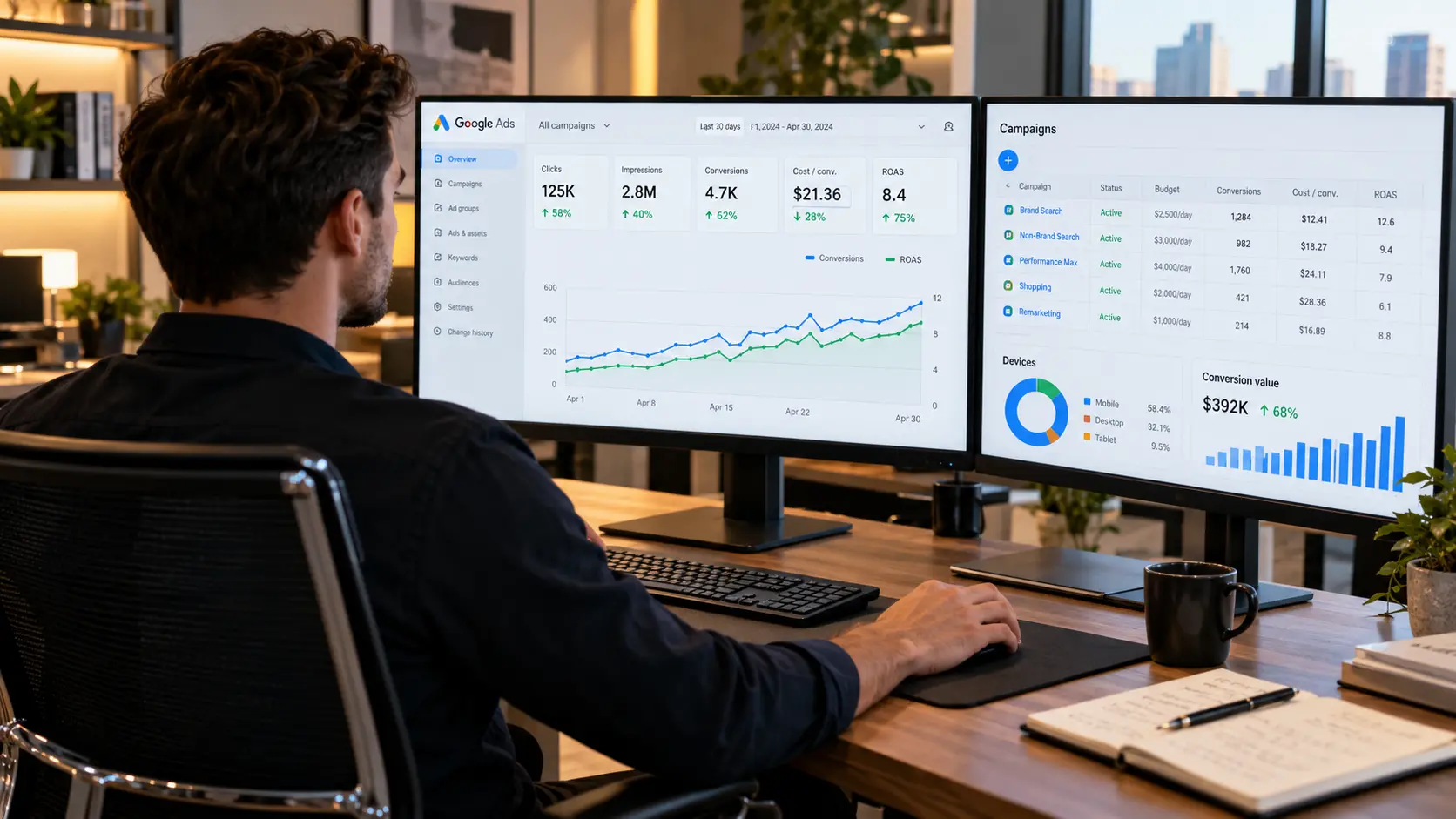
Google Ads: Be the Right Answer When People Are Searching
Meta introduces brands to people.
Google often appears at a different moment: when people are already looking for something.
A product. A service. A solution. A brand.
That is what makes Google Ads powerful.
But visibility alone is not enough.
You need to answer the right search with the right message and the right experience.
At Gein Agency, we do not treat Google Ads as a matter of adding keywords and launching campaigns.
We connect search intent, media strategy, ad messaging, landing page experience, measurement and optimization into one performance system.
What Is Google Ads?
Google Ads is an advertising platform designed to help brands appear at moments when users are searching, comparing, watching, researching and making decisions across Google’s ecosystem.
It is not limited to Search campaigns.
Depending on the business, Google Ads can include:
- Google Search Ads
- Performance Max
- Google Shopping
- YouTube Ads
- Display Ads
- Remarketing
The right campaign mix depends on the business model, user behavior and growth objective.
Our Google Ads Approach
We start with search intent.
Two people can type similar keywords into Google and still be looking for very different things.
One may be researching.
Another may be comparing options.
Someone else may already be ready to buy.
That is why we do not build Google Ads strategy around search volume alone.
We also consider:
- Search intent
- Commercial value
- Competition
- Keyword cost
- Conversion potential
- Landing page relevance
- The actual business objective
Not every search has the same value.
Search Ads: Meeting Demand at the Right Moment
Search campaigns are one of the most direct and powerful parts of Google Ads.
The user is already actively looking for a product, service or solution.
The challenge is not simply to appear.
The ad needs to respond to what the user is actually trying to find.
Our Search Ads work may include:
- Keyword research
- Search intent analysis
- Campaign structure
- Ad group planning
- Ad copy
- Negative keyword management
- Match type strategy
- Bid strategy
- Conversion tracking
- Landing page alignment
Keyword Strategy
Keyword strategy is not about finding the highest-volume search terms.
The real opportunity is often in understanding what the person behind the keyword actually wants.
Searches within the same category may represent very different needs:
- Informational searches
- Product comparisons
- Price research
- Brand searches
- High-intent purchase searches
- Location-based searches
Each may require a different message, offer and landing page.
A strong keyword strategy is less a list of words and more a map of user intent.
Brand vs Non-Brand Campaigns
Someone searching directly for your brand is not in the same position as someone searching for the category for the first time.
That is why brand and non-brand campaigns should usually be evaluated separately.
Brand Campaigns
These focus on users who already know the brand and are actively searching for it.
Non-Brand Campaigns
These focus on users who may not know the brand yet but are searching for the product or service category.
The two campaign types serve different purposes and should not be judged by exactly the same performance criteria.
Negative Keywords
In Google Ads, knowing where you do not want to appear can be just as important as knowing where you do.
Negative keyword management can help:
- Reduce irrelevant traffic
- Protect budget
- Improve search relevance
- Increase conversion quality
That is why we regularly review search term data.
Sometimes better performance starts not with getting more traffic, but with removing the wrong traffic.
Performance Max
Performance Max is Google’s automation-led campaign type that can access multiple placements across Search, Shopping, YouTube, Display, Discover, Gmail and Maps.
When used correctly, it can be powerful for e-commerce and conversion-focused businesses.
But automation is not the same as strategy.
Performance Max still depends on areas such as:
- Conversion goals
- Asset groups
- Audience signals
- Creative assets
- Product feed quality
- Search themes
- Budget allocation
- New customer acquisition
- Campaign exclusions
- Performance interpretation
We give Google room to learn.
But we still define what meaningful performance looks like for the business.
Google Shopping
For e-commerce brands, Google Shopping can place products directly in front of users who are already searching for them.
The user can see the product, image and price before reaching the website.
That means Shopping performance depends on more than campaign settings.
The product feed is part of the advertising itself.
Our Google Shopping work may include:
- Google Merchant Center setup
- Product feed review
- Product title optimization
- Product description quality
- Category mapping
- GTIN and product identifier checks
- Feed diagnostics
- Product segmentation
- Campaign structure
- Conversion value optimization
Why Product Feed Quality Matters
In Google Shopping, the product feed often functions as the ad copy itself.
Incomplete or inaccurate product data can:
- Reduce visibility
- Cause poor search matching
- Limit campaign performance
- Create Merchant Center issues
That is why we do not treat feed optimization as a purely technical task.
We also optimize how the product is described to the search engine.
YouTube Ads
Google Ads is not only about search.
YouTube can be a strong channel for awareness, product education, remarketing and video storytelling.
YouTube Ads can support goals such as:
- Audience strategy
- Video creative
- Short-form video
- Remarketing
- Product storytelling
- Brand awareness
- Conversion-focused video
This is where Gein’s production and storytelling capabilities naturally connect with paid media.
Ad Copy Is More Than a Headline
In Google Search, the user is already looking for something.
That means the role of ad copy is not only to attract attention, but to set the right expectation.
When writing Google Ads copy, we look at:
- Search intent
- Value proposition
- Product or service differentiation
- Trust signals
- CTA
- Landing page message match
A strong ad does not just tell the user to click.
It gives them a reason to.
Landing Page Alignment
Even a strong ad can underperform if the landing page does not support the promise made in the search result.
If someone searches for a specific service, sending them to a generic homepage may not always be the best experience.
That is why we may review areas such as:
- Message match
- H1 and content hierarchy
- CTA structure
- Mobile experience
- Page speed
- Form structure
- Trust signals
- Conversion friction
Bid Strategy
Google Ads offers different manual and automated bidding strategies.
Depending on the campaign, these may include:
- Maximize Clicks
- Maximize Conversions
- Maximize Conversion Value
- Target CPA
- Target ROAS
The right strategy depends on data volume, campaign goals and the quality of the conversion setup.
Automation trained on poor data can optimize toward the wrong outcome.
Conversion Tracking
Reliable conversion data sits at the center of Google Ads optimization.
Depending on the project, we may review:
- Google Ads conversion tracking
- Google Analytics 4
- Google Tag Manager
- E-commerce tracking
- Lead tracking
- Form submissions
- Phone conversions
- Purchase events
- Enhanced Conversions
The goal is not to mark every interaction as a conversion.
The goal is to measure the actions that genuinely matter to the business.
Remarketing
Not every user converts on the first visit.
Google Ads remarketing can help reconnect with people who have already visited the site or interacted with the brand.
Remarketing audiences may include:
- Website visitors
- Product viewers
- Cart abandoners
- YouTube viewers
- Customer lists
The purpose of remarketing should not be to follow people endlessly.
It should be to show the right message when the user is closer to making a decision.
Google Ads and SEO Are Not Competitors
SEO builds organic visibility over time.
Google Ads can create faster visibility, especially for high-intent searches.
When the two work together, they can also teach each other.
For example:
- Ads data can reveal high-converting keywords.
- SEO data can uncover new paid search opportunities.
- Landing page insights can improve both channels.
- Brand and non-brand search behavior can be analyzed together.
That is why we do not treat paid search and organic search as completely separate worlds.
ROAS Is Not the Only Metric That Matters
ROAS is especially important for e-commerce brands.
But it does not tell the whole story.
Depending on the business objective, we may also evaluate:
- ROAS
- CPA
- CAC
- CPL
- Conversion Rate
- CTR
- CPC
- Impression Share
- Conversion Value
- Revenue
- New Customer Acquisition
- Lead Quality
What matters most is not the platform metric itself, but the business outcome behind it.
Budget Management
Distributing budget evenly across every campaign is not always the best approach.
We may consider factors such as:
- Search intent
- Campaign profitability
- Conversion volume
- Seasonality
- Margin
- Search demand
- Growth potential
The goal is not simply to spend the budget. It is to understand where that budget can create the most value.
Our Google Ads Services
At Gein Agency, Google Ads management is shaped around the needs of each brand.
Our capabilities include:
- Google Ads strategy
- Search Ads management
- Performance Max
- Google Shopping
- YouTube Ads
- Remarketing
- Keyword research
- Search intent analysis
- Negative keyword management
- Campaign structure
- Bid strategy
- Conversion tracking
- Google Merchant Center
- Product feed optimization
- Landing page analysis
- Campaign optimization
- Reporting and analysis
Our Google Ads Process
01 — Understand the Goal
We analyze what the brand wants to grow, who the audience is and how current campaigns are performing.
02 — Map Search Demand
We identify keywords, search intent and opportunity areas.
03 — Validate Measurement
We make sure the conversion tracking setup is reliable enough to guide optimization.
04 — Build the Campaign Structure
We plan Search, Performance Max, Shopping or other campaign types according to the objective.
05 — Launch and Learn
We analyze search terms, user behavior and conversion data.
06 — Optimize
We improve budget allocation, bidding, keywords, ad copy and landing pages based on real performance.
Who Is Google Ads For?
Google Ads can be especially valuable for:
- Brands looking to capture active search demand
- E-commerce businesses focused on sales growth
- Companies generating leads
- Brands targeting high-intent users
- E-commerce websites using Google Shopping
- Businesses entering new markets
- Teams dissatisfied with their current Google Ads performance
Frequently Asked Questions
What is the difference between Google Ads and SEO?
Google Ads provides paid visibility and can generate traffic while campaigns are active. SEO focuses on building organic visibility over time. They do not need to compete with each other and often work better together.
How quickly can Google Ads generate results?
Traffic and early conversion signals can appear quickly, but meaningful optimization requires enough data to understand performance patterns.
What is the minimum budget for Google Ads?
There is no universal minimum. Keyword costs, industry, target market, product value and expected conversion volume all influence the required budget.
Is Performance Max right for every business?
No. Performance Max can be powerful, but it is not automatically the best option for every brand. Conversion data, asset quality, product feed quality and business objectives should all be considered.
Do I need Google Merchant Center for Shopping Ads?
Yes. Product data needs to be submitted through Google Merchant Center in order to run Shopping campaigns.
Why am I generating sales but still seeing low ROAS?
High CPC, low conversion rate, low average order value, poor keyword quality or low-margin products can all reduce ROAS. That is why campaign settings, landing page performance and business economics should be evaluated together.
Does Gein also manage Google Merchant Center and product feeds?
When needed, Merchant Center setup, feed quality, product titles, category structures and feed diagnostics can be included as part of the Google Ads strategy.
Search Already Exists. The Goal Is to Be the Right Answer.
The power of Google Ads comes from appearing when someone is already looking for something.
But visibility alone does not create results.
You need to understand the search, shape the right message, send the user to the right page and measure what happens next accurately.
The user asks.
Google shows the options.
Strategy makes your brand the right answer.
That is how we approach Google Ads at Gein Agency.
A new brand, a new campaign or an idea you cannot quite name yet. Let’s talk.